
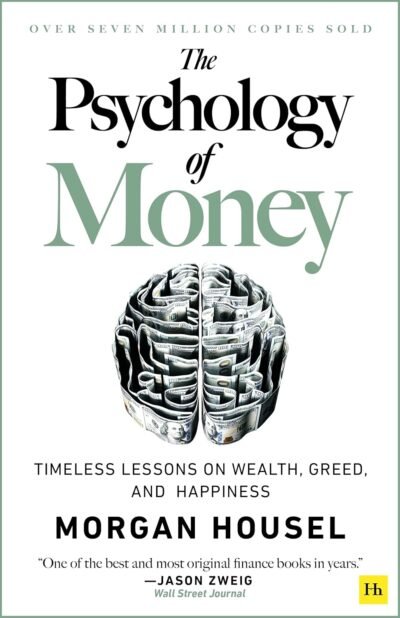
Price: $22.00
(as of Aug 09, 2025 18:38:39 UTC – Details)
**OVER 8 MILLION COPIES SOLD AROUND THE WORLD… The Psychology of Money is the original bestselling classic from the author of the new book, Same as Ever.**
Doing well with money isn’t necessarily about what you know. It’s about how you behave. And behavior is hard to teach, even to really smart people.
Money―investing, personal finance, and business decisions―is typically taught as a math-based field, where data and formulas tell us exactly what to do. But in the real world people don’t make financial decisions on a spreadsheet. They make them at the dinner table, or in a meeting room, where personal history, your own unique view of the world, ego, pride, marketing, and odd incentives are scrambled together.
In The Psychology of Money, award-winning author Morgan Housel shares 19 short stories exploring the different ways people think about money and teaches you how to make better sense of one of life’s most important topics.
From the Publisher


Add to Cart
Add to Cart
Customer Reviews
4.7 out of 5 stars 64,065
4.7 out of 5 stars 64,065
4.7 out of 5 stars 64,065
Price
$35.00$35.00 $19.71$19.71
— no data
Other editions no data
no data
Publisher : Harriman House
Publication date : September 8, 2020
Language : English
Print length : 256 pages
ISBN-10 : 0857197681
ISBN-13 : 978-0857197689
Item Weight : 2.31 pounds
Dimensions : 5.4 x 0.8 x 8.4 inches
Best Sellers Rank: #42 in Books (See Top 100 in Books) #1 in Budgeting & Money Management (Books) #1 in Introduction to Investing #4 in Success Self-Help
Customer Reviews: 4.7 4.7 out of 5 stars 64,065 ratings var dpAcrHasRegisteredArcLinkClickAction; P.when(‘A’, ‘ready’).execute(function(A) { if (dpAcrHasRegisteredArcLinkClickAction !== true) { dpAcrHasRegisteredArcLinkClickAction = true; A.declarative( ‘acrLink-click-metrics’, ‘click’, { “allowLinkDefault”: true }, function (event) { if (window.ue) { ue.count(“acrLinkClickCount”, (ue.count(“acrLinkClickCount”) || 0) + 1); } } ); } }); P.when(‘A’, ‘cf’).execute(function(A) { A.declarative(‘acrStarsLink-click-metrics’, ‘click’, { “allowLinkDefault” : true }, function(event){ if(window.ue) { ue.count(“acrStarsLinkWithPopoverClickCount”, (ue.count(“acrStarsLinkWithPopoverClickCount”) || 0) + 1); } }); });
Customers say
Customers find this finance book well-written and packed with wisdom, with short chapters that make it easy to read. They appreciate its historical data to prove its points and consider it a good starting point for beginners, particularly for those starting in investing. While many find it entertaining and engaging, some customers consider it a waste of time.








Larry Frank –
Timeless nuggets of wisdom
Psycholology of Money: Timeless Lessons on Wealth, Greed and Happiness by Morgan Housel is a timeless work about how our feelings, emotions and interactions with money often results in different outcomes for different people – because people are different. So, insights into how to think and behave about money is instructive.You may think you don’t have enough money to make a difference for your future. I think this book will show you, how even with those thoughts, that you can.Others may believe they have more than enough. Those too are risky thoughts and beliefs.Because people are different, everyone should read this book to see what you uniquely learn about yourself and how you should think about money.Chocked full of great insights to guide us all.Quotes that hit home from various chapters are presented below. There are many more quotes possible, but then you’d miss the message between each quote. I strongly suggest getting the book to see how these below snippets string together into a powerful story about how we think and behave towards money matters.Quote:• Your personal experiences with money make up maybe 0.00000001% of what’s happened in the world, but maybe 80% of how you think the world works.• Luck and risk are siblings.• Yes, but I have something he will never have … enough.• There is no reason to risk what you have and need for what you don’t have and don’t need.• The hardest financial skill is getting the goalpost to stop moving.• $81.5 billion of Warren Buffett’s $84.5 billion net worth came after his 65th birthday.• Buffett began serious investing when he was 10 years old.• His skill is investing, but his secret is time. That’s how compounding works.• But good investing isn’t necessarily about earning the highest returns, because the highest returns tend to be one-off hits that can’t be repeated. It’s about earning pretty good returns that you can stick with and which can be repeated for the longest period of time. That’s when compounding runs wild.• Getting wealthy vs. staying wealthy.• Getting money is one thing. Keeping it is another.• Planning is important, but the most important part of every plan is to plan on the plan not going according to plan.• No one is impressed with your possessions as much as you are.• When you see someone driving a nice car, you rarely think, “Wow, the guy driving that car is cool.” Instead, you think, “Wow, if I had that car people would think I’m cool.”• Humility, kindness, and empathy will bring you more respect than horsepower ever will.• Spending money to show people how much money you have is the fastest way to have less money.• Money has many ironies. Here’s an important one: Wealth is what you don’t see.• Past a certain level of income people fall into three groups: Those who save, those who don’t think they can save, and those who don’t think they need to save.• Building wealth has little to do with your income or investment returns, and lots to do with your savings rate.• The value of wealth is relative to what you need.• Past a certain level of income, what you need is just what sits below your ego.• People’s ability to save is more in their control than they might think.• Things that have never happened before happen all the time.• The thing that makes tail events easy to underappreciate is how easy it is to underestimate how things compound. How, for example, 9/11 prompted the Federal Reserve to cut interest rates, which helped drive the housing bubble, which led to the financial crisis, which led to a poor jobs market, which led to tens of millions to seek a college education, which led to [over a trillion dollars] in student loans with [a high percentage of default rates].• The correct lesson to learn from surprises is that the world is surprising.• The most important part of every plan is planning on your plan not going according to plan.• The purpose of the margin of safety is to render the forecast unnecessary.• The End of History Illusion is what psychologists call the tendency for people to be keenly aware of how much they’ve changed in the past, but to underestimate how much their personalities, desires and goals are likely to change in the future. [Thus, their history of change won’t change anymore into their future].• Every job looks easy when you’re not the one doing it.• Successful investing looks easy when you’re not the one doing it. Hold stocks for the long run … but do you know how hard it is to maintain a long-term outlook when stocks are collapsing?• Price … not dollars and cents … it’s volatility, fear, doubt, uncertainty … all of which are easy to overlook until you’re dealing with them in real time.• Beware of taking financial cues from people playing a different game than you are.• When investors have different goals and time horizons – and they do in every asset class – prices that look ridiculous to one person can make sense to another, because the factors those investors pay attention to are different.• The interesting thing about [absolutely pessimistic] stories is that their polar opposite – forecasts of outrageous optimism – are rarely taken as seriously as prophets of doom.• Pessimism just sounds smarter and more plausible than optimism.• …progress happens too slowly to notice, but setbacks happen too quickly to ignore.• The more you want something to be true, the more likely you are to believe a story that overestimates the odds of it being true.• We don’t know what we don’t know.• Coming to terms with how much you don’t know means coming to terms with how much of what happens in the world is out of your control. And that can be hard to accept.• Less ego, more wealth.• If you want to to do better as an investor, the single most powerful thing you can do is increase your time horizon.Unquote.There’s a lot of wisdom alone in the various quotes above. There’s even more wisdom reading how they string together to see the larger story line to understand your psychology of money applied in your own life.Each person reading Housel’s work will get something different out of it than someone else. And each time you read it (I suggest more than once) you too will get yet still something else out of it.
Wehash Technology –
The Psychology of Money: A Masterclass on Wealth, Human Nature, and True Happiness
Morgan Housel’s The Psychology of Money is not your typical finance book. It’s an insightful and profound exploration of how human behavior, rather than cold hard numbers, often determines financial success—or failure. If you’re looking for a book that teaches you how to manage wealth, understand greed, and find happiness, this is a timeless treasure trove of wisdom that transcends spreadsheets and stock markets.Lessons in Human Behavior, Not Just FinanceHousel’s genius lies in his ability to connect finance to human psychology, showing how our emotions, biases, and decision-making habits influence our financial outcomes. Unlike most personal finance books that focus on technical advice, this one delves deep into the mindset required to build and maintain wealth. Through engaging storytelling and real-life anecdotes, Housel illustrates that how we think about money is often more important than what we actually know about it.The Power of Compounding BehaviorOne of the book’s core messages is the immense power of compounding—not just in terms of investments but in life itself. Housel masterfully explains how small, consistent decisions can lead to huge gains over time, whether in wealth-building, relationships, or personal growth. He reminds us that patience and discipline are the cornerstones of financial success, and that short-term thinking is often the enemy of long-term wealth. His examples of how figures like Warren Buffet amassed fortunes through simple, disciplined investing make this concept strikingly clear.Greed: The Silent Wealth KillerGreed is one of the most destructive forces in personal finance, and Housel addresses it head-on. Through stories of financial bubbles, crashes, and personal downfalls, he shows how the relentless pursuit of “more” can derail even the most secure fortunes. His exploration of why it’s so hard for people to “have enough” is a sobering reminder that wealth is as much about mindset as it is about numbers. The book doesn’t just highlight the dangers of greed; it also offers practical ways to avoid falling into its trap by cultivating a sense of financial contentment.Happiness Beyond the Dollar SignsWhile the title suggests that money is the focus, happiness is the true heart of this book. Housel argues that wealth, when viewed properly, is a tool for freedom rather than a scorecard. His chapters on the importance of controlling your time, living below your means, and the intangible rewards of financial security are powerful reminders that happiness isn’t just about how much you earn, but how well you live. He masterfully weaves together the idea that wealth is not the end goal, but a means to achieve a life filled with joy, autonomy, and purpose.Timeless Lessons for Every ReaderWhat sets The Psychology of Money apart is its universal appeal. Whether you’re a seasoned investor, a financial novice, or someone simply seeking a healthier relationship with money, the book’s lessons are relevant and accessible. Housel’s conversational writing style makes complex concepts feel straightforward, and his ability to blend financial advice with psychology and philosophy makes this book a must-read for anyone wanting a holistic approach to money and life.Final Verdict: A Wealth of WisdomMorgan Housel’s The Psychology of Money is a masterpiece of personal finance and self-awareness. Its lessons on wealth, greed, and happiness go far beyond dollars and cents, challenging readers to rethink their relationship with money and life itself. This book isn’t just about getting rich—it’s about getting smart, getting wise, and getting happy. A timeless, essential read for anyone looking to master not just their money, but their mindset.
Zero –
what an amazing book. it really opens your mind about how you see wealth and money.my personal rating 11/10.
Mbali Ngwenya –
Good read.
Sophia –
Lots of great advice! It’s really great! I’ve learned a lot from this, and I’d highly recommend it to anyone who is wanting to learn to be optimistic, broaden their horizons, and be reasonable, not rational! 10/10 would reccomend!
Dennis Jacobs –
I am going to re-read this book because it entails lots of different stories that tells you about money in different contexts. It’s a MUST have if you’re either a money chaser or are in the stock market, or crypto world. Or, maybe you just want to become rich…but this book won’t tell you how to get rich: it gives you examples of other people’s experiences with money. Apply the knowledge in your life and you’ll become extremely wealthy.
KTG –
一般的な語彙で簡潔に書かれているので、英検準一級程度の語彙力と読解力があれば英語で読める。英語学習にも適切な一冊。