
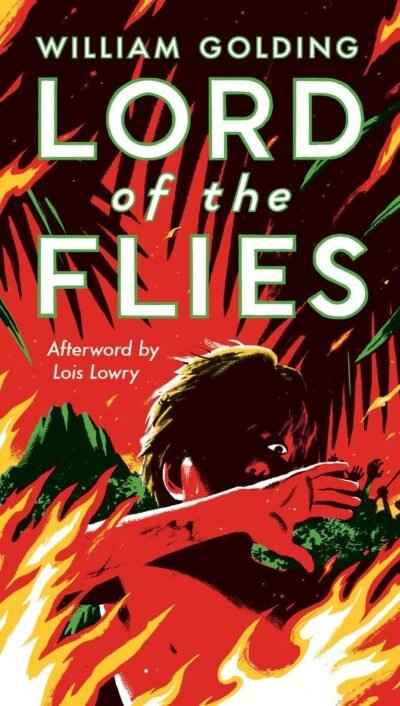
Price: $12.00 - $6.59
(as of Aug 08, 2025 19:45:59 UTC – Details)
Golding’s iconic 1954 novel, now with a new foreword by Lois Lowry, remains one of the greatest books ever written for young adults and an unforgettable classic for readers of any age.
This edition includes a new Suggestions for Further Reading by Jennifer Buehler.
At the dawn of the next world war, a plane crashes on an uncharted island, stranding a group of schoolboys. At first, with no adult supervision, their freedom is something to celebrate. This far from civilization they can do anything they want. Anything. But as order collapses, as strange howls echo in the night, as terror begins its reign, the hope of adventure seems as far removed from reality as the hope of being rescued.
From the Publisher


Publisher : Penguin Books
Publication date : December 16, 2003
Edition : Reissue
Language : English
Print length : 224 pages
ISBN-10 : 0399501487
ISBN-13 : 978-0399501487
Item Weight : 4.2 ounces
Reading age : 12+ years, from customers
Dimensions : 4.25 x 0.59 x 7.5 inches
Lexile measure : 770L
Best Sellers Rank: #28 in Books (See Top 100 in Books) #2 in Teen & Young Adult Classic Literature #7 in Classic Literature & Fiction #17 in Literary Fiction (Books)
Customer Reviews: 4.5 4.5 out of 5 stars 51,627 ratings var dpAcrHasRegisteredArcLinkClickAction; P.when(‘A’, ‘ready’).execute(function(A) { if (dpAcrHasRegisteredArcLinkClickAction !== true) { dpAcrHasRegisteredArcLinkClickAction = true; A.declarative( ‘acrLink-click-metrics’, ‘click’, { “allowLinkDefault”: true }, function (event) { if (window.ue) { ue.count(“acrLinkClickCount”, (ue.count(“acrLinkClickCount”) || 0) + 1); } } ); } }); P.when(‘A’, ‘cf’).execute(function(A) { A.declarative(‘acrStarsLink-click-metrics’, ‘click’, { “allowLinkDefault” : true }, function(event){ if(window.ue) { ue.count(“acrStarsLinkWithPopoverClickCount”, (ue.count(“acrStarsLinkWithPopoverClickCount”) || 0) + 1); } }); });
Customers say
Customers find the book well-written and thought-provoking, particularly appreciating its symbolic content and exploration of human nature. The book receives positive feedback for its beautiful landscape descriptions and value for money, with customers noting it’s not bad for its price. Customers disagree on the pacing, with some describing it as a fast read while others find it slow-moving. The ending receives mixed reactions, with some finding it worth the read while others criticize its lack of explanation, and customers disagree on whether it’s engaging or boring.








JWolf –
Lord of the Flies 50th Anniversary Edition
THIS EDITION: “Lord of the Flies” 50th Anniversary Edition, by William Golding (winner of the 1983 Nobel Prize in Literature), boasts a beautiful hard-bound cover and includes an introduction from E.M. Forster, biographical and critical notes by E.L. Epstein, and illustrations from Ben Gibson.Golding, William, 1911-1993——-Lord of the flies/William Golding–1st Perigee hardcover ed., 50th anniversary ed., p. cm. “A Perigee book.”ISBN: 978-0-399-52920-7OVERVIEW: Author William Golding’s debut novel, “Lord of the Flies,” was first published in 1954. It follows R.M. Ballantyne’s “The Coral Island” and further delves into the fundamentals of human nature by depicting the `what-would-happen?’ of a group of young boys who have become stranded on an island–one previously untainted by man. One of the central themes of the novel concerns two opposing ideas about society, i.e.: democracy versus autocracy. Other phenomena explored exist as struggles over morality, rational thought, and individuality, contrasted by immorality, emotional thought, and group-think, respectively. When I was young and first read this book, I was embarrassed to say it was among my top five favorite novels. I thought that admitting how captivated I was by “Lord of the Flies” would make me sound sadistic; I didn’t have a good explanation for what I liked about it. As an adult, I’ve come to realize that what I appreciated so highly was this novel’s impeccable use of allegories and seemingly innocuous symbolism. Even today, this is a book that, in my opinion, tells a highly valuable story–not only for young adults, but old adults as well.NOTABLE ACHIEVEMENTS: Following its premiere printing, “Lord of the Flies” managed to sell a meager 3,000 copies. Almost a decade later, the novel saw a resurrection and quickly gained notoriety in schools and on best-seller lists.▪ 1963: Film-adaptation by Peter Brook▪ 1990: Film-adaptation by Harry Hook▪ 1990-1999: American Library Association’s “100 Most Frequently Challenged Books”–#68▪ 2003: BBC’s Survey “The Big Read”–#70▪ —-: Modern Library’s “100 Best Novels: Editor’s List”–#41▪ —-: Modern Library’s “100 Best Novels: Reader’s List”–#25▪ 2005: TIME Magazine’s “100 Best English-Language Novels from 1923-2005.”SUMMARY: Amid a worldwide nuclear war, a British evacuation aircraft crashes into the Pacific Ocean; the only survivors are a group of like-aged school and choir boys between the ages (presumably) of six and twelve. On the deserted and unspoiled island, two of the children, Ralph and Piggy, come upon a conch shell which, when blown, permits Ralph to gather the remainder of the marooned party to one central location. When the strayed survivors see that it is Ralph who summoned them all together, they naturally cling to this occurrence as the first action which remotely resembles stability and, thus, leads to the group’s naming of Ralph as their chief. Ralph’s only opposition comes from the choir group which prefers Jack Merridew as chief. All of the boys, from both the school and choir groups, note the conch as the tool which has bestowed upon Ralph his rank; the conch quickly becomes a symbol of power for he who possesses it.In his first order of business, Ralph declares two primary objectives: (1.) have fun, and (2.) alert passing ships to the boys’ position by smoke signal. In order to spread some of the responsibility, Ralph creates a `cabinet’ of sorts; in this analogy: Jack, who leads the choir group in search of food, is the secretary of war; Simon, who is responsible for overseeing the shelter provisions (and who takes to caring for the younger boys, aka. “littleuns”) is the secretary of homeland security; and Piggy–and overweight, glasses-wearing, and continuously mocked outcast–becomes Ralph’s confidant and right-hand-man.Without any rules or repercussions for failing to keep order, the tribe deteriorates; most of the boys prefer to spend their time not on constructive measures, but rather on developing a new island religion which revolves around an imaginary beast. Perhaps subconsciously, Jack seizes the widespread fear of the beast as an opportunity to gain followers; he makes a vow to slay the beast responsible for tormenting the islanders and, thus, free his people of their woes. Ralph, who is more concerned with necessities for survival, loses ground to Jack, the usurper. Because the “society” members in charge of maintaining the smoke signal have given into the blood-lust promised by the beast hunt, the entire island misses the chance to be rescued by a passing vessel.Despite the recent deterioration of the chain-of-command (and Ralph’s constant deflection of personal insecurities onto Piggy), Piggy convinces Ralph that he must retain leadership for the good of the tribe. In the middle of the night, Sam and Eric–a set of twins now tasked to feed the smoke signal–mistake the body of a downed fighter pilot for the beast, leading them to abandon their post in order to recoup with the others. The new confirmation of the beast’s existence causes a complete dissolution of Ralph’s position as chief; Jack forms his own tribe and celebrates by sacrificing a boar and leaving the head as offering to the beast.In the wake of the turmoil, Simon wanders off by himself and comes across the boar-head-offering. The decomposing head is now swarmed with flies. [It is not entirely clear, but likely that Simon experiences a seizure while looking upon the “Lord of the Flies.”] He hallucinates that the fly-covered head is alive, smiling, and speaking to him; it tells him that the “beast” is nothing more than a manifestation of the evil inside them all. Simon goes on to investigate the downed parachutist mistaken by Sam and Eric for the beast; even though Simon knows his discovery of the truth about the beast will mean trouble for him, he hurries back to the feast to alert them all of their foolishness and, hopefully, shed proper light on the situation.Dark and in the middle of ritual feast and dance, the savagery of Jack’s tribe becomes evident as the boys willingly mistake Simon for the beast and kill him. For Ralph, Piggy, Sam, and Eric, the realization that they have murdered a friend–one who wanted only to show them “the way”–brings them to their senses; they sever ties with Jack’s tribe. Since Piggy’s glasses are the only means the boys have of sparking fire, Jack feels that their absence from his camp on Castle Rock (a mountainous area of the island) poses a threat to his command; under cover of darkness, Jack and his followers steal the spectacles.Piggy, perhaps the only `adult-like’ character, believes what Jack really wants is the conch because, to Piggy, a tool which provides means of gathering everyone together is far more important that one which only serves to burn. Angered by Jack’s immaturity, Ralph, Piggy (carrying the conch), Sam, and Eric journey to Castle Rock to retrieve Piggy’s glasses. Not willing to be challenged, Jack orders Sam and Eric to be taken hostage and tortured. Roger, Jack’s henchman, thrives in the society which allows him to act unbounded; he kills Piggy by smashing him with a boulder, destroying the conch–the last symbol of civility–in the process. Ralph barely escapes the slaughter, but is soon hunted by Jack and his tribe. In an attempt to `smoke him out,’ Jack and his followers set fire to the island. As Ralph begins to consider his eminent death, readers can’t help but be reminded of an earlier point in the book when Simon calmly, and almost prophetically, spoke to Ralph “You’ll get back to where you came from…. I just think you’ll get back all right (p.154).”The once pure island has now become an inferno; the billows of smoke have managed to signal a passing naval vessel just in the nick of time, as Jack’s tribe is hot on Ralph’s tail. Ralph–tired, frightened, beaten, and hopeless–encounters the naval officer who has come to his rescue. At the sight of the adult’s presence, Ralph is finally relieved of his `responsibility to humanity;’ Jack and his tribe are paralyzed as if they had been playing characters in some other-worldly video game, with the officer representing `Game Over.’ A sense of shame hits each of the boys when the officer suggests that, being British, the boys should have known how to conduct a proper society… “Ralph looked at him dumbly. For a moment he had a fleeting picture of the strange glamour that had once invested the beaches. But the island was scorched up like dead wood–Simon was dead…. Ralph wept for the end of innocence, the darkness of man’s heart, and the fall through the air of the true, wise friend called Piggy (p.286).”
Jackson Mayo –
Lord of the Flies Review
William Goldberg’s novel Lord of Flies tells the story of a group of British boys who are involved in a plane crash and find themselves deserted on a stranded island during World War II. The boys rejoice in their new-found freedom since no adults survived the crash; however, they soon realize that chaos is never a good thing. Without order or civility, the true colors of the boys begin to show, and they realize that social order is crucial to their survival.Needing a sense of structure, the boys elect one of the boys, Ralph, as the chief of the group. Ralph then assigns roles and duties to each of the other boys to survive until they can be rescued. This seems like a good solution to their problem until rumors begin that a monster is residing on the island with the boys. The boys decide to give a sacrifice to the monster in the form of a bloody boar’s head, which in time decays becoming “Lord of the Flies.” This unknown monster “fear” ultimately lives inside each of the boys causing it to consume every moment of the boys’ days and nights turning the boys against one another. Their make-shift society quickly begins to unravel creating a conflict between the need for order and the savage nature of human beings.The novel delves deep into the four main characters showing how chaos can truly change a person and make one do things that he never imagined he could do. The first character is Ralph, who is elected chief of the group. Ralph is determined to maintain order within the group. When the boys first arrive on the island, Ralph blows a conch shell like a make-shift horn signaling all the lost boys from the island to descend upon the group. The second character is Piggy, who is smart and insightful. Piggy becomes the most mature of the group; however, he is soon mocked by the other boys due to his physique. Another character Jack is the hunter of the group and delights in hunting for wild pigs on the island. Jack slowly develops a following of other boys who want to hunt, and this leads to a power struggle between Ralph’s followers and Jack’s group. The last of the boys is Simon, the quiet type who likes to venture into the jungle to find solitude away from the others. However, Simon’s solitude becomes his downfall when he starts to become crazy leading to the other boys killing Simon thinking he is the monster of their dreams.The climax of the novel begins after Piggy is killed, and Ralph, Jack, and one of the island’s lost boys named Roger set fire to the entire island. Knowing he is the next to be killed by the group of savages, Ralph runs away and straight into the arms of a British naval officer signaling the end of the haunting journey for the remaining boys. When the boys realize that they have been rescued, they burst into tears realizing what the evil that they have become.Human nature, the struggle between good and evil, and the ultimate darkness of man are central themes throughout the story detailing how even good people can be savage if it means survival. The haunting story is a scary reminder that human depravity makes people do things unimaginable. The struggle between savagery and civilization is something our own society has dealt with since the beginning of time. The novel is a classic story that bleeds over into our world today and details how fear can be used as a weapon when needed to achieve a desired outcome. Goldberg’s novel Lord of the Flies is dark and disturbing at times, but it opens the reader’s eyes to how human nature ultimately controls us all.
Y.G. –
Someone said, a tragedy is a story where you can comprehend every step of the protagonists and foresee their final falling down the cliff, but cannot hinder it. When Mr. Golding worked on this story, seemingly he had such a tragedy in mind.Before I read this story, I have already heard a lot about it, about the evil in human nature, dystopia, etc, which made me even more surprised to see with how much love and empathy Mr. Golding proceeded with the story telling.In this story, no one is perfect, but everyone carries some virtue with him. Even Jack, who ended up as the barbaric despotic leader, started as someone aiming to contribute to the commons, just like every other boy in this story. The boys also have learnt the first democratic rules, such as voting, assembly, and speaking only when the conch is in his hands.It is interesting how Mr. Golding distributed different virtues among the children. Piggy, the one who is best capable of rational reasoning, is fat and lazy. Simon, the one who is best capable of empathy and the only one who could have helped the children to get relieved from their fear, is incapable of good speaking and regarded as batty. He died first, killed by those he liked, thus not able to relieve the children from their fear, which contributed to their drifting to the cruelty.Ralph is the one with the most leadership quality and also chosen as the leader at the beginning. He is no idealized hero who unites all virtues in himself, in fact, there is no such hero in this story, everyone has some drawbacks, has also a lovable side, just like in the real life.Jack is the charismatic challenger. He has hardly any empathy, but he is motivated by doing things he deems as right. In fact, most children in this story think he is right, namely you have to sort the people from good to bad and treat them accordingly. Jack accepted Ralph as the leader because Ralph is good: physically strong, speaks fluently, ready to take the responsibilities. He started to hate Ralph because Ralph is unjust from his point of view: Ralph even listens to Piggy, the fatty boy who is mocked by almost everyone, while his effort to do good for the commons, namely to get meat for the children, is not appreciated. BTW, there is a reason why Ralph has something against getting meat, but you have to read it on your own.IMHO, this is actually a story for adults, not only for children. While no adult would make silly things like being scared of a dead body and mistaking it for a beast, almost all adults must understand the ominous murmuring “the beast is in us”. Look at that dispute between getting meat and keeping fire, look at that killing in frenzy, look at that attempt of denial and avoidance after the first murder, doesn’t it look familiar to you?It seems to me that Mr. Golding is trying to reconstruct the fallbacks during the transition from barbarism to civilization, but I should not say too much, because the most fun of reading is to form ones own opinions. As Ralph keeps saying to himself in this story when he is in danger, “think”. Keep thinking even if you are past 18.
Bindiya Naulakha –
Paper quality is poor and inferior!
Nicolás –
Lo compré de segunda mano. Vino en perfecto estado excepto algunas anotaciones a lápiz que fueron fácilmente eliminables con una goma.El libro en sí es una gran lectura. Historia tensa llena de analogías con la vida real y simbolismos que llevan a posarse preguntas desde el ambito político hasta el antropológico. No es un libro infantil o juvenil.Recomiendo su lectura a alguien que quiera leer un libro más serio.
Eman Almohammed –
The book was an exercise for the mind, the vocab is way too advanced and made me search for the meaning of every word, got me tired but also taught me many new words. Excellent book but the advanced vocab got me way too tired.
Margie Taylor –
It kept coming to me while reading Michael Wolff’s Fire and Fury: Inside the Trump White House – the similarities between the chaos, duplicity and treachery taking place in Washington and William Golding’s tale of a group of children marooned on a tropical island. Lord of the Flies is a world without grown-ups – as, it would seem, is the current West Wing.Inspired by Golding’s experiences during World War II, Lord of the Flies tells the story of a group of schoolboys who are being evacuated from England during a fictional atomic war. Their plane is shot down somewhere over a tropical island in the Pacific and only the children survive. (Why the plane, departing from England, is anywhere near the Pacific Ocean is never explained.) There has been a storm, which washed the wreckage of the plane out to sea; now, in its aftermath, two of the boys, Ralph and Piggy, meet up on the beach.When they discover a large, cream-coloured conch shell floating among the weeds, Peggy suggests that Ralph blow into it to summon the others. With Piggy’s instructions, Ralph is eventually able to create a deep, harsh booming sound that reverberates across the island. Slowly, in groups of twos and threes, the children appear out of the foliage, in various stages of undress:“Some were naked and carrying their clothes; others half-naked, or more or less dressed, in school uniforms, grey, blue, fawn, jacketed, or jerseyed. There were badges, mottoes even, stripes of color in stockings and pullovers. Their heads clustered above the trunks in the green shade; heads brown, fair, black, chestnut, sandy, mouse-colored; heads muttering, whispering, heads full of eyes that watched Ralph and speculated. Something was being done.”The assembled boys include a school choir, all dressed in black, led by a tall older boy named Jack; he and Ralph immediately stand out as natural leaders. But Ralph holds the conch, he’s the one who has summoned them, and when it comes to a vote it’s Ralph who’s chosen to be chief. As a sop to Jack’s pride, Ralph decides that Jack and his choir will hunt food for the group.In the beginning the boys are excited to have the island to themselves -“No grownups!” But Piggy, who is sidelined because he’s overweight, asthmatic and wears glasses, is more thoughtful. He reminds them that the adults, as far as they know, are all dead, having being killed in the bombing: “Nobody don’t know we’re here. Your dad don’t know, nobody don’t know–” His lips quivered and the spectacles were dimmed with mist. “We may stay here till we die.”Ralph announces that they must build a fire on the top of the mountain and keep it burning. Smoke will give a signal to any passing ship – smoke is their only hope of rescue. At this stage, the boys are fired with enthusiasm for having proper rules – meetings will be held on a makeshift platform, and the one holding the conch will speak without interruption. Rules are important, after all … in the absence of adults, rules will keep them safe.Some of them, however, fear they’re not safe. There’s a beast, says one of the younger boys. It comes in the night and disappears in the morning. Although the older boys scoff and try to laugh it off, it leaves an impression. When the body of the downed pilot, trapped in his parachute, is discovered in the dark, rising and falling in the wind, the boys are led to believe the horrifying truth – the Beast is real. And it is terrifying.The description of the hunters’ first kill is a nightmare of violence and bloodlust. The pig is a sow; one moment she’s dozing peacefully in the sun, nursing her piglets, the next she’s being sliced and hacked and butchered to death. Afterwards, they sharpen a stick at both ends and impale the head of the sow on it, a gift for the Beast:“. . . the head hung there, a little blood dribbling down the stick. Instinctively the boys drew back too; and the forest was very still. They listened, and the loudest noise was the buzzing of flies over the spilled guts.”After this, the division sharpens between Jack and his hunters, intent on finding more pigs to kill, and Ralph’s followers who want to build shelters, keep the fire going and abide by the rules of the conch. The hunters become more and more “savage”, painting themselves in mud and charcoal, while Ralph and Piggy cling to what they remember of civilization. “The world, that understandable and lawful world, was slipping away.” Roger, at one point, starts throwing stones at a “littleun”, being careful not to hit him:“Here, invisible yet strong, was the taboo of the old life. Round the squatting child was the protection of parents and school and policemen and the law. Roger’s arm was conditioned by a civilization that knew nothing of him and was in ruins.”Jack becomes a symbol for evil…for why things “break up”, as Ralph puts it. But Simon, the mystic, lost in a hallucinatory conversation with the pig’s head – the Lord of the Flies – knows otherwise:“‘Fancy thinking the Beast was something you could hunt and kill!” said the head. For a moment or two the forest and all the other dimly appreciated places echoed with the parody of laughter. “You knew, didn’t you? I’m part of you? Close, close, close! I’m the reason why it’s no go? Why things are what they are?”Simon rushes to tell the others: there is no beast, the evil is within them. He blunders into the middle of a ritual celebratory dance by the hunters and is murdered. The others – Piggy and Ralph, and the twins, Sam and Eric – tell themselves Simon’s death is not their fault. They weren’t part of the murderous dance that destroyed Simon. It was an accident, Piggy says. It was dark, they were scared – there’s no good to be got from thinking about it. They create a new version of the facts, one they can live with. One that suits their purposes.Right to the end, up to the moment when he realizes Jack means to kill him, Ralph calls it a game – Jack and his hunters aren’t playing fair, they’re not playing by the rules. Rules created by adults in a sensible, civilized society. An English society, of course, which has no use for “savage” behaviour. Piggy, holding the conch, the talisman of sense, of law and order, demands: “Which is better–to be a pack of painted Indians like you are, or to be sensible like Ralph is?”Fear and anarchy win out. The leadership changes; in Jack, the new chief, we have a vision of authority without responsibility. Authority as it might be envisioned by a child. A spoiled, impulsive child, lacking compassion. Those who refuse to fall in with the new order are outcasts, despised and derided by the group. They are “the other”; as such, they’re fair game for insults, ostracism, even death.Sound familiar?